

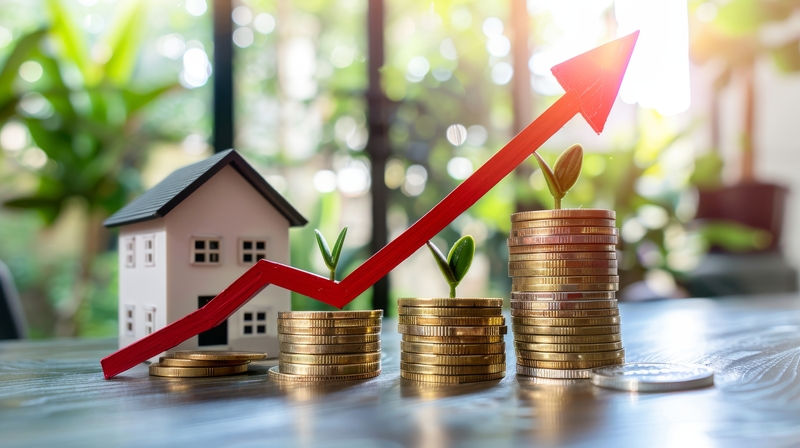
When you buy a car, its value drops right away. But your home usually goes up in value over time. Keep reading to find out if that means your home will definitely increase in value.
Owning a home has many benefits. One key benefit is appreciation, which means your home’s value usually goes up over time. For example, if you bought your home 10 years ago for $200,000, it might be worth $300,000 now. That’s a $100,000 increase in value.
So, why does appreciation matter?
Homeowners want their homes to be worth more when they sell so they can make a bigger profit.
For instance, if you bought a home for $250,000 and later sold it for $350,000 while owing $180,000 on your mortgage, you’d make a $170,000 profit on the sale.
You won’t keep all that profit because you’ll have to pay your real estate agent’s commission and other closing costs. Still, the more your home’s value goes up, the more money you’ll make when you sell.
Appreciation also matters if you want a home equity loan. Equity is the difference between what you owe on your mortgage and what your home is worth. For example, if your home is worth $350,000 and you owe $280,000, you have $70,000 in equity.
You can borrow against that equity with a home equity loan or line of credit. You can use the money for anything, like paying off high-interest credit card debt or remodeling your kitchen.
When your home’s value goes up more, you build equity faster and can borrow more with home equity loans or lines of credit.
Do homes always go up in value?
Historically, homes tend to increase in value over time. Staying in your home for at least five years can improve your chances of seeing its value rise.
But price appreciation isn’t guaranteed. Like any investment, your home’s value could go down. For example, if you bought a house in 2007, at the start of the Great Recession, its value might have dropped in the following years.
You can take steps to improve the chances that your home’s value will go up. One way is to buy in a strong, desirable neighborhood. Location is still the most important factor in a home’s value.
Also, think about the size and condition of the home when buying. A well-maintained home is more likely to increase in value. So, it’s important to keep up with maintenance. If you neglect your home, it could lose value.
You can also raise your home’s value by making updates that buyers like, such as adding a primary bathroom or updating an old kitchen.
Sometimes, you can’t control your home’s value. If the national economy struggles, home values might drop across the country. In those cases, your best option is to wait for the housing market to recover.
Remember, your home isn’t just an investment with financial potential. Its real value is as your place of comfort and happiness, and that matters just as much.